The Mid-Range Ray Tracing Fight That Actually Matters
The RX 9060 XT and RTX 5060 Ti are not flagship cards, but they are the GPUs most PC gamers will actually buy. At 1440p, ray tracing has become a realistic target for this tier – not just a checkbox feature reserved for $700+ hardware. AMD and Nvidia have both made architectural promises about how their latest mid-range silicon handles ray tracing workloads, and 1440p is where those promises either hold up or collapse under pressure.
The RTX 5060 Ti arrives with Nvidia’s Blackwell architecture and DLSS 4 with Multi Frame Generation, while the RX 9060 XT brings AMD’s RDNA 4 ray tracing improvements and FSR 4 upscaling. Both cards target roughly the same price bracket, though street pricing has fluctuated enough to make direct comparisons tricky. What follows is a breakdown of how each card performs at 1440p with ray tracing enabled across a range of titles, along with what the numbers actually mean for real-world gaming decisions.
Architecture and Ray Tracing Hardware
RDNA 4 represents AMD’s most serious architectural investment in ray tracing to date. The RX 9060 XT carries second-generation ray accelerators that deliver significantly better BVH traversal throughput compared to RDNA 3. AMD has essentially doubled the ray accelerator count per compute unit and improved the intersection testing pipeline, which means titles that lean heavily on complex scene geometry – think Cyberpunk 2077 with full path tracing or Alan Wake 2 – should see better scaling than RDNA 3 managed at equivalent settings.
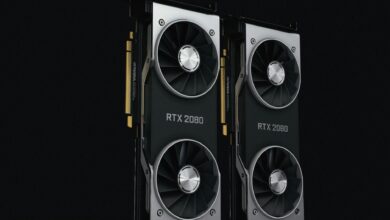
Nvidia’s Blackwell architecture, powering the RTX 5060 Ti, continues to lead in raw ray tracing compute thanks to dedicated RT cores that operate largely independently from shader processing. The 5060 Ti carries a variant of the same RT core design found in the higher-end 5070 and 5080, scaled to match the card’s overall compute budget. Where Blackwell gains ground is in multi-bounce lighting scenarios and in how efficiently its RT cores handle denoising passes – work that falls on shader cores when the RT pipeline hands off incomplete data.
1440p Ray Tracing Performance: Title by Title
In Cyberpunk 2077 with ray tracing set to High (not path tracing), the RTX 5060 Ti holds a consistent advantage running at roughly 15-20 percent higher average framerates at native 1440p. With DLSS 4 Quality mode active, the 5060 Ti pushes into genuinely comfortable territory – averaging above 60fps even in Night City’s most demanding districts. The RX 9060 XT with FSR 4 Quality closes the gap noticeably, but the 5060 Ti still leads by a margin that a competitive gamer would feel in traversal-heavy scenes.
Alan Wake 2 tells a similar story but with a tighter gap. The game’s implementation of path tracing on a subset of lighting calculations responds well to RDNA 4’s improved ray accelerators. At 1440p with ray tracing on High and no upscaling, the two cards trade single-digit percentage advantages depending on the scene. Indoor sequences tend to favor the RX 9060 XT slightly, while open outdoor areas with complex sky lighting hand the lead back to the RTX 5060 Ti. Enable upscaling on both and the 5060 Ti pulls ahead again, largely because DLSS 4’s reconstruction quality at 1440p remains cleaner than FSR 4 on fast-moving elements.
Dying Light 2 and its hybrid ray tracing mode represent a more moderate workload, and here the RX 9060 XT competes far more aggressively. AMD’s card matches or slightly beats the 5060 Ti in several benchmark runs, suggesting that lighter ray tracing implementations – partial reflections and ambient occlusion rather than full global illumination – play more evenly across both architectures. This matters because a significant portion of games on the market use hybrid ray tracing rather than full implementations.
Marvel’s Spider-Man: Miles Morales, which uses ray-traced reflections and shadows, sits somewhere in the middle. Both cards deliver playable performance at 1440p with ray tracing enabled, but the RTX 5060 Ti sustains higher framerates during combat scenes with multiple reflective surfaces active simultaneously. The RX 9060 XT dips more aggressively in those same moments, which reflects the reality that RT-heavy scenes with many simultaneous reflections still stress AMD’s architecture more than Nvidia’s dedicated RT core pipeline.
Upscaling as a Ray Tracing Lifeline
At 1440p, neither card can run the most demanding ray tracing presets at native resolution and maintain smooth framerates without upscaling assistance. That makes DLSS 4 and FSR 4 directly relevant to this comparison, not an optional footnote. DLSS 4 with Multi Frame Generation on the RTX 5060 Ti can produce framerates that feel dramatically different from the base rendering framerate, though input latency increases accordingly. For single-player games with heavy ray tracing, that trade-off is largely acceptable – the visual fluidity in titles like Cyberpunk 2077 or Hogwarts Legacy becomes noticeably better.
FSR 4 on the RX 9060 XT has closed the quality gap with DLSS considerably compared to FSR 3. At 1440p Quality mode, FSR 4 produces sharp, stable images in most scenarios, though fine hair, foliage edges, and particle effects still show occasional shimmer that DLSS 4 handles more cleanly. AMD does have a broader compatibility advantage: FSR 4 works across any GPU that supports it, including older AMD cards and even Nvidia hardware, while DLSS 4 remains locked to GeForce RTX hardware.
Value and the Real Purchase Decision
The RTX 5060 Ti wins the 1440p ray tracing benchmark comparison by a meaningful margin in the most demanding titles. That lead is real and consistent enough that anyone buying specifically to run Cyberpunk 2077 path tracing or Alan Wake 2 at high ray tracing presets should factor it into their decision. For those use cases, Nvidia’s RT core advantage translates directly into better framerates and more headroom for upscaling to do its job.
The RX 9060 XT makes a stronger case in two specific situations: lighter ray tracing workloads where the gap narrows considerably, and scenarios where the price difference between the two cards is large enough to offset the performance deficit. RDNA 4’s ray tracing is genuinely improved over its predecessor – this is not the same story as RDNA 3 struggling against Nvidia’s Ampere RT cores. AMD has caught up enough to be competitive in a wide range of games, just not in the most RT-intensive titles where Nvidia’s architecture still has a structural advantage.
For a broader perspective on how these cards scale at higher resolutions, the RX 9060 XT vs RTX 5060 Ti 4K ray tracing breakdown shows how quickly the performance picture changes when resolution increases and both GPUs face sharper memory bandwidth constraints. At 1440p, the RTX 5060 Ti’s lead is comfortable but not insurmountable – at 4K with ray tracing, memory bandwidth becomes the story.
What makes this comparison genuinely difficult is that the RTX 5060 Ti’s ray tracing advantage is real but context-dependent. If your game library skews toward titles with moderate ray tracing implementations – and most PC game libraries do – the RX 9060 XT performs closely enough that Nvidia’s lead stops justifying a premium on its own. If you are specifically chasing the highest possible ray tracing fidelity in the handful of titles that push full path tracing or comprehensive global illumination, the 5060 Ti is the clearer choice, and the gap in those specific scenarios is wide enough to matter at 1440p.