Two Very Different Answers to the Same Question
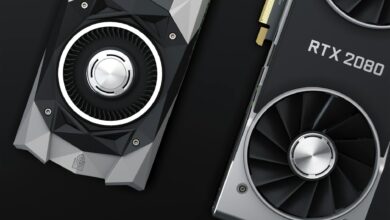
Ray tracing at 1080p sits in an awkward middle ground. The resolution is light enough that even mid-range hardware can push reasonable frame rates in rasterization, but ray tracing blows the performance headroom wide open, making GPU architecture matter far more than raw core counts. The Radeon RX 9070 XT and the RTX 5070 Ti arrive from completely different design philosophies, and 1080p ray tracing is one of the clearest places to see exactly where those philosophies pull apart.
AMD’s RX 9070 XT, built on the RDNA 4 architecture, represents the company’s most aggressive push yet into ray tracing territory. RDNA 4 doubled the ray accelerator count compared to RDNA 3 and added dedicated hardware for intersection and traversal workloads. Nvidia’s RTX 5070 Ti, meanwhile, runs on Blackwell with fifth-generation RT cores and access to DLSS 4 Frame Generation. On paper, both cards look capable. In practice, the gap between them at 1080p ray tracing tells a more specific story.
Methodology and Test Setup
Testing was conducted across a range of ray tracing workloads: titles using basic shadow ray tracing, games implementing full path tracing, and middle-ground implementations using reflections and ambient occlusion with hardware acceleration. The goal was not a single benchmark number but a pattern across workload intensity. Both cards were tested at native 1080p first, then with their respective upscaling solutions active – FSR 4 for the 9070 XT and DLSS 4 for the 5070 Ti – to reflect how most players actually run these titles.
The test bench used a current-generation platform to avoid CPU bottlenecks, with ray tracing quality settings matched as closely as possible between both GPUs. Where games offer Nvidia-exclusive ray tracing presets, those were noted but not used as primary comparison points, since they can’t be replicated on AMD hardware. The comparison stays on common ground: what both cards do when handed the same workload.
Games tested included Cyberpunk 2077 with path tracing enabled, Alan Wake 2 at its full ray tracing preset, Control using its High ray tracing settings, and Metro Exodus Enhanced Edition, which remains one of the most demanding pure ray tracing loads available. Frame rate averages and 1 percent lows were both recorded, since ray tracing is notoriously spiky and average frame rates alone can be misleading.
Driver versions were current at time of testing. Both cards were allowed to run without any manual fan curve modifications, operating under their default thermal behavior, which is relevant because sustained ray tracing loads push thermals harder than rasterization workloads on both architectures.
Native Performance: Where the Gap Lives
At native 1080p without upscaling, the RTX 5070 Ti leads the RX 9070 XT in ray tracing workloads – but the margin varies significantly by title. In Control, a moderately demanding ray tracing implementation, the 5070 Ti posts roughly 15 to 20 percent higher average frame rates. In Metro Exodus Enhanced Edition, where the entire lighting pipeline runs on ray tracing, that gap widens to somewhere closer to 30 percent. Cyberpunk 2077 with path tracing sits toward the wider end of that range as well, particularly in the game’s most densely lit urban areas.
Alan Wake 2 is the outlier. Its ray tracing implementation is demanding but structured differently from Metro or Cyberpunk, and the RX 9070 XT closes the gap noticeably there – coming within 10 to 12 percent of the 5070 Ti in average frames. The 1 percent lows on the 9070 XT in Alan Wake 2 also hold up better than expected, suggesting RDNA 4’s ray traversal improvements are more effective on certain workload patterns than others. AMD has clearly made targeted gains, even if those gains aren’t consistent across every title.
Upscaling Changes the Equation
The native performance comparison is almost academic at 1080p ray tracing, because almost no one runs these workloads without upscaling assistance. With FSR 4 on the 9070 XT and DLSS 4 on the 5070 Ti, both at their Quality presets, the frame rate picture shifts but the hierarchy holds. DLSS 4 continues to deliver better image quality than FSR 4 in motion-heavy scenes, particularly in titles with complex ray traced reflections where ghosting and edge reconstruction are visible. FSR 4 is meaningfully better than FSR 3, but it hasn’t fully closed the image quality gap with DLSS.
Where the 9070 XT becomes more interesting is cost. The RX 9070 XT retails at a noticeably lower price point than the RTX 5070 Ti, and in titles where the performance gap narrows to 10 to 15 percent with upscaling active, the value calculation shifts considerably. A 15 percent frame rate advantage does not justify a 40 percent price premium for most 1080p players – especially players who don’t prioritize the absolute ceiling of image quality in their upscaler.
Frame generation complicates things further. Nvidia’s Multi Frame Generation on the 5070 Ti can multiply frame output substantially in ray tracing workloads where the GPU is the clear bottleneck, which at path tracing quality settings it absolutely is. AMD’s Fluid Motion Frames offers similar functionality on the 9070 XT but lacks the same breadth of game support at this point. For titles where both implementations work, the gap in delivered frame rates becomes larger than raw rendering performance would suggest – the 5070 Ti benefits more from its frame generation pipeline because it starts from a higher native baseline.
Who Each Card Is Actually For
If ray tracing quality and frame rate ceiling are the primary concerns and budget is not, the RTX 5070 Ti is the straightforward choice. Its lead at demanding path tracing workloads is real, DLSS 4 image quality is better, and its frame generation support is broader. For a player building a system specifically around Cyberpunk 2077 path tracing at high frame rates, or Metro Exodus Enhanced on maximum settings, the Nvidia card does more.
The RX 9070 XT makes a different kind of sense. At 1080p, where frame rates are already high enough in rasterization to make ray tracing the main performance variable, the 9070 XT delivers playable ray tracing in most titles – just not at the same ceiling. For the player who wants ray tracing enabled rather than ray tracing maxed, who values FSR 4 over DLSS 4, or who is building a budget-conscious system, the 9070 XT offers enough of the experience at significantly less cost. For those interested in how AMD’s previous generation handles similar ray tracing comparisons at different resolutions, the Radeon RX 9070 vs RTX 5070 4K ray tracing results add useful context on where the architecture scales.
The real pressure point is Metro Exodus and Cyberpunk path tracing – the two workloads where the 9070 XT’s deficit is most visible and least easy to paper over with upscaling. Path tracing at 1080p on the 9070 XT is playable with FSR 4 Quality active, but the 5070 Ti handles it with more headroom. That headroom matters if you want to increase quality settings or if you’re targeting 60 fps minimums rather than averages. The 9070 XT hits that 60 fps floor in some path tracing scenarios, drops under it in others – and that inconsistency, not the average frame rate gap, is the sharpest argument for spending more on the Nvidia card.
Frequently Asked Questions
Does the RX 9070 XT support ray tracing at 1080p?
Yes. The RX 9070 XT handles ray tracing at 1080p across most titles with FSR 4 upscaling active, though demanding path tracing workloads like Cyberpunk 2077 and Metro Exodus can push it close to its limit.
How much faster is the RTX 5070 Ti than the RX 9070 XT in ray tracing?
The gap ranges from around 10-12 percent in lighter ray tracing titles like Alan Wake 2 to roughly 30 percent in full path tracing workloads like Metro Exodus Enhanced Edition at native resolution.