Two Flagship CPUs, One Brutal Workload
AMD’s Ryzen 9 9950X3D and Intel’s Core Ultra 9 285K sit at the top of their respective consumer CPU lineups, and both carry price tags that demand serious justification. Most gaming benchmarks focus on rasterization, where frame rates are high enough that CPU differences can blur together. Ray tracing at 4K is a different animal – it hammers the GPU with deferred lighting calculations and BVH traversal, which in turn creates a very specific kind of CPU bottleneck dependency. That pressure point is exactly where the architectural differences between these two processors become visible.
The Ryzen 9 9950X3D brings AMD’s 3D V-Cache technology to the Zen 5 architecture for the first time in a desktop flagship configuration, stacking an additional 64MB of L3 cache on top of its compute chiplet. The Core Ultra 9 285K, running on Intel’s Arrow Lake architecture, ditches hyperthreading and bets on improved IPC and a hybrid core layout. Neither chip was designed with pure gaming performance as its primary pitch – both are workstation-class processors that happen to game. Seeing which one survives a ray-traced 4K session is where the story gets interesting.

Test Setup and Methodology
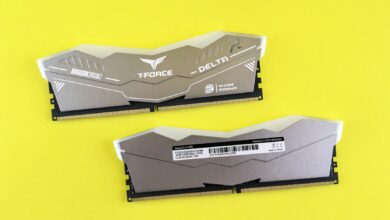
For this comparison, both processors were paired with an RTX 4090 to minimize GPU variance and keep the focus on CPU throughput and cache behavior. The Ryzen 9 9950X3D ran on an X870E motherboard at default PBO settings, while the Core Ultra 9 285K ran on a Z890 board with performance mode enabled in the UEFI. Both systems used DDR5-6000 in dual-channel configuration, which is the established sweet spot for AMD’s Infinity Fabric and a competitive frequency for Arrow Lake’s memory controller.
Games tested include Cyberpunk 2077 with path tracing enabled via the Overdrive preset, Alan Wake 2 with full ray tracing, and Spider-Man: Miles Morales with RT reflections and shadows maxed. All titles were run at 4K native without upscaling to isolate raw rendering demand. Frame timing data was captured using CapFrameX across five-minute runs, and 1% lows were weighted heavily since ray-traced workloads are notorious for stuttering rather than sustained framerate collapse.
One variable worth flagging: Cyberpunk 2077’s path tracing mode is particularly sensitive to VRAM bandwidth and shader compilation stalls, which can occasionally punish either platform depending on driver state. Both systems ran the same GPU driver version, and shader caches were pre-warmed before recording began to avoid first-run anomalies distorting the data.
Where the 3D V-Cache Actually Matters
In Alan Wake 2 with full ray tracing, the Ryzen 9 9950X3D posted a meaningful 1% low advantage – roughly eight to ten frames per second ahead of the Core Ultra 9 285K in the most demanding outdoor sequences. The reason connects directly to how ray tracing workloads generate CPU-side traffic. As the GPU processes BVH traversal and deferred shading, it generates irregular memory access patterns that push scene geometry data back through the CPU’s cache hierarchy. The 9950X3D’s 3D V-Cache dramatically reduces the latency cost of those cache misses, keeping the GPU fed with less stall time. It is the same mechanism that made the 7800X3D dominant in traditional rasterization titles, just playing out in a different workload context.
Cyberpunk 2077 under the Overdrive path tracing preset told a more nuanced story. Average frame rates at 4K native – which were low enough to be GPU-bound regardless – showed minimal separation between the two chips. The 9950X3D pulled ahead again when looking at frame time consistency, particularly during driving sequences in Night City where the scene complexity spikes rapidly. The Core Ultra 9 285K’s frame pacing was noticeably less stable in those moments, producing micro-stutter patterns visible in the frame time graph even when the average FPS readout looked similar.
Spider-Man: Miles Morales was the closest contest of the three. The workload in that title is more structured and less geometry-intensive than open-world ray tracing scenarios, which reduces the cache pressure that gives the 9950X3D its edge. Both CPUs delivered smooth, consistent frame times in this title, and the 1% lows were within a margin that would not register perceptually during play. For anyone primarily interested in ray-traced performance in console-port style titles with tighter scene budgets, the argument for spending extra on 3D V-Cache weakens considerably.
The Core Ultra 9 285K had one clear area of advantage across all three titles: application-level CPU task completion during loading and asset streaming. Arrow Lake’s hybrid architecture, with its blend of P-cores and E-cores, handled background compilation and decompression tasks faster than the 9950X3D. In practical terms, that means shorter load times and slightly faster shader compilation on first boot into a new area. During actual rendered gameplay, that advantage disappears. The 285K is a better all-around processing platform; the 9950X3D is the better gaming chip, including under ray-traced workloads where that was far from obvious before launch.

The Price-to-Performance Reality
The Ryzen 9 9950X3D carries a launch MSRP above $700, placing it firmly in the category of CPUs that require a specific use case to justify. If you are already running a productivity-heavy workflow that needs the thread count – video encoding, 3D rendering, large compilation jobs – and you want the best possible gaming performance without switching chips, the 9950X3D is an unusually capable all-in-one answer. The ray tracing performance advantage confirmed here is not marginal noise; it shows up repeatedly and in the metric that matters most for perceived smoothness, which is frame timing rather than average FPS.
The Core Ultra 9 285K is cheaper, more widely available, and performs better in multi-threaded professional workloads that benefit from E-core offloading. For a pure gaming build, spending that much on either processor is already a difficult argument to make when mid-range CPUs like the Ryzen 5 9600X or Core Ultra 5 245K close a large portion of the performance gap at a fraction of the price. But for the buyer who is committed to a flagship build and plays titles where ray tracing is a primary concern – Cyberpunk, Alan Wake 2, or whatever Remedy and CD Projekt Red release next – the 9950X3D’s frame time consistency under maximum RT load is not something the 285K can currently match.