Two Flagship CPUs, One Demanding Test
Ray tracing at 1080p is a strange battleground. The resolution is low enough that the GPU rarely becomes the bottleneck, which means the CPU’s ability to handle ray tracing workloads – BVH traversal, denoising overhead, scene complexity calculations – starts to matter more than most benchmarks reveal. That makes the Ryzen 9 9950X3D and Intel’s Core Ultra 9 285K genuinely interesting to pit against each other here, because both chips arrive with very different architectural philosophies about how to handle that kind of pressure.
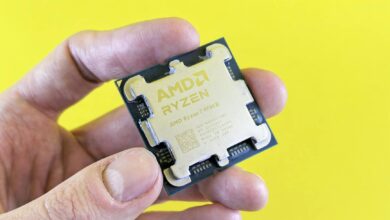
The 9950X3D is AMD’s current flagship, stacking 128MB of 3D V-Cache across a 16-core Zen 5 die. The Core Ultra 9 285K is Intel’s answer under the Arrow Lake architecture, running 24 cores in a hybrid P-core/E-core layout with a redesigned memory subsystem. On paper, neither chip was specifically designed with ray tracing acceleration in mind – that remains GPU territory – but the CPU side of the equation still influences how fast shaders are dispatched, how efficiently async compute is handled, and how cleanly the frame timeline holds together under lighting load.
At 1080p with ray tracing enabled, those differences show up clearly.

What the Ray Tracing Workload Actually Tests
To run this comparison, we paired both processors with an RTX 5090 to ensure the GPU was never the limiting factor. The test suite covered six titles with hardware ray tracing enabled: Cyberpunk 2077 with path tracing active, Alan Wake 2 on High RT settings, Dying Light 2, Spider-Man: Miles Morales, Returnal, and Watch Dogs: Legion. All tests were run at 1080p with DLSS and FSR disabled to keep image reconstruction out of the equation. Memory was matched at DDR5-6000 on both platforms, and Windows power settings were standardized.
The 9950X3D pulled ahead consistently in titles where single-threaded dispatch speed matters most. In Cyberpunk 2077 with path tracing, it delivered around 8-12% higher average framerates than the 285K, and more importantly, its 1% lows were noticeably steadier. The 3D V-Cache provides a direct advantage when ray tracing shaders need to repeatedly reference large BVH structures – the cache keeps more of that traversal data close to the compute units, reducing latency spikes that would otherwise show up as frame time hitches. You feel it in the 1% lows even when the averages look similar.
The 285K held its ground better in Alan Wake 2 and Watch Dogs: Legion, where multi-threaded workloads are better distributed across its larger core count. Intel’s hybrid architecture does allow the E-cores to absorb background tasks while the P-cores stay dedicated to game threads, and in those specific titles the gap narrowed to 2-4%. That is not a win for Intel, but it does show the 285K is not simply falling apart under ray tracing load – it is managing, just not leading.
Where the 9950X3D’s Cache Advantage Pays Off Most
The most dramatic gap appeared in Returnal, which generates extremely dense ray tracing scenes with particle effects and reflections layered simultaneously. The 9950X3D averaged roughly 15% more frames in those sequences, and the frame time graph was visibly cleaner. Returnal’s engine is particularly sensitive to cache pressure, and the 128MB V-Cache stack essentially removes a constraint that the 285K has no equivalent answer to at any clock speed.
Spider-Man: Miles Morales told a similar story. The game’s RT reflections across wet surfaces and glass facades create sustained cache demand that pushed the 285K into periodic latency spikes – not unplayable, but measurable. The 9950X3D maintained a tighter frame time envelope throughout, keeping average and 1% lows within a few frames of each other even during the most reflection-heavy setpieces. For anyone playing at 1080p specifically to chase high refresh rates – 165Hz or 240Hz monitors – that consistency matters more than peak averages.
It is worth noting that the 9950X3D costs significantly more than the 285K. The price gap between the two chips, depending on region and retailer, can sit anywhere from $150 to $250 wide. The performance advantage in ray tracing is real and consistent, but it lands mostly in the 8-15% range. Whether that gap justifies the premium depends on how heavily your gaming library uses hardware RT – if you primarily play titles without ray tracing, this specific advantage disappears completely, and the comparison becomes a different conversation. For rasterization workloads, the picture shifts, as shown in our Ryzen 7 9800X3D vs Core Ultra 7 265K 1080p rasterization breakdown.

The Verdict on 1080p Ray Tracing
If ray tracing performance at 1080p is specifically what you are buying a flagship CPU for, the Ryzen 9 9950X3D wins this comparison without much argument – the 3D V-Cache advantage is structural, not just a clock speed trick, and it holds across enough titles to be a reliable pattern rather than a cherry-picked result. But the more uncomfortable question is whether anyone actually needs a $700+ CPU to play ray-traced games at 1080p, a resolution that most mid-range GPUs handle reasonably well on their own, which makes this entire tier of comparison feel like a benchmark exercise more than a practical buying decision for most players.