Two Mid-Range CPUs, One Battleground
At 1080p, the CPU matters more than most people want to admit. With a fast GPU doing less of the heavy lifting at lower resolutions, bottlenecks shift upstream – and that is exactly where the AMD Ryzen 5 9600X and Intel Core Ultra 5 245K end up competing most directly.
The Setup: What Each CPU Brings to the Fight
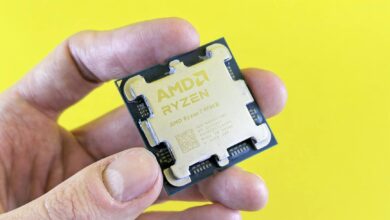
The Ryzen 5 9600X sits on AMD’s Zen 5 architecture, running 6 cores and 12 threads with a boost clock of up to 5.4 GHz. It draws relatively little power for its performance class, which keeps thermals manageable and makes it an appealing option for mid-range builds that are not centered around heavy workstation loads. AMD paired it with the AM5 platform, which continues to offer a longer upgrade path than Intel’s recent socket history has managed to deliver.
The Core Ultra 5 245K is a different kind of chip. Built on Intel’s Arrow Lake architecture, it comes with 14 cores split across a hybrid design – 6 P-cores and 8 E-cores – and a boost clock reaching 5.2 GHz on the performance cores. Intel’s approach here leans into thread count for multitasking and background processing rather than raw single-threaded speed, which is an important distinction when the topic is 1080p gaming specifically. Arrow Lake’s IPC improvements over Raptor Lake were modest at launch, and the platform drew criticism early on before Intel shipped microcode and BIOS updates that improved gaming performance considerably.
For this comparison, both chips were paired with DDR5 memory running at 6000 MHz – the established sweet spot for Ryzen 9000 series – and the Core Ultra 5 245K ran at DDR5-6400 in line with Arrow Lake’s preferred memory profile. The GPU used throughout testing was an NVIDIA RTX 4090, deliberately chosen to remove the graphics card as a variable. At 1080p, this setup makes CPU differences far easier to isolate in real game data.
Motherboard choices matter here too. The 9600X ran on an X670E board with EXPO enabled, while the 245K used a Z890 board with Intel’s XMP profile active. Neither system was overclocked beyond rated boost speeds. Power limits on the 245K were left at stock, where Intel recommends letting the chip operate freely within its thermal envelope rather than imposing arbitrary watt caps.

Game-by-Game Performance: Where Each Chip Wins and Loses
In CPU-bound titles, the Ryzen 5 9600X performs very well. Games like Cyberpunk 2077 in the city center at 1080p Ultra show the 9600X pulling ahead on average framerates by a narrow but consistent margin. Zen 5’s improved branch prediction and higher IPC compared to Zen 4 give AMD an edge in scenarios where a single heavily-threaded render thread determines throughput. The 245K closes that gap when scenes become less CPU-intensive – open-world areas with fewer NPCs and script events tend to equalize the two chips quickly.
Counter-Strike 2 is where things get genuinely interesting. Valve’s Source 2 engine is notoriously CPU-heavy and responds well to fast single-threaded performance. At 1080p with competitive settings, the 9600X delivers higher minimum framerates in some scenarios, but the 245K’s E-cores handle background Windows processes without touching the P-cores, which translates to more consistent frame pacing under load. Competitive players running other applications in the background – Discord, browser tabs, stream software – will likely feel this difference before they see it in benchmarks.
Alan Wake 2 and Baldur’s Gate 3 sit on the opposite end of the spectrum. These titles tax both the CPU and GPU heavily, and at 1080p with an RTX 4090, the GPU often steps in as the limiter during the most graphically intensive moments. When neither chip is bottlenecking the frame, the 245K’s extra E-cores help smooth out background tasks while the P-cores drive the game thread. Average framerates between the two chips narrow to within a few percent – well under the threshold where any player would notice.
Starfield and The Last of Us Part I – both known for stuttering and background streaming issues – tell a more nuanced story. The 245K’s hybrid core arrangement gives the operating system more flexibility in task assignment, which can reduce hitching caused by asset streaming competing with game logic on the same cores. The 9600X’s tighter core count means these competing loads occasionally share resources in ways that produce brief frame drops. Neither chip eliminates the problem entirely, since both games have engine-level issues that no CPU fully resolves.
In Elden Ring and older titles running DX11, the 9600X’s single-threaded lead becomes more pronounced. DX11 games often do not scale well across many cores, making high-frequency, high-IPC cores the determining factor. The 9600X’s Zen 5 cores at 5.4 GHz hit a consistent ceiling that the 245K’s P-cores, topping out slightly lower, do not quite match. For anyone with a library heavy on older or less-optimized titles, this advantage compounds across a typical gaming session.
Power, Heat, and Value
The 9600X runs cooler and pulls fewer watts under gaming loads. AMD’s 65W TDP (configurable up to 88W) keeps it comfortable on mid-range air coolers, and real-world power draw during gaming typically stays under 80W. The 245K in unrestricted mode can spike well above 150W during combined CPU loads, though in gaming-only scenarios it tends to settle lower. Still, the thermal and power delta between the two chips is real, and it matters for builds where case airflow is limited or cooling budget is tight.
The pricing picture complicates a clean recommendation. The Ryzen 5 9600X has settled into a competitive street price that makes it easier to justify, especially when factoring in the lower platform cost. AM5 boards have come down considerably since the platform launched. The Z890 boards suited to the Core Ultra 5 245K still carry a premium, and DDR5 at the speeds Intel prefers adds a small but real cost. If the build starts from scratch, the AMD platform delivers more performance per dollar at 1080p. If someone already owns a compatible Intel board from 12th or 13th Gen, that calculus changes – though Arrow Lake requires a new platform entirely, so that upgrade path does not actually exist here.
The Verdict on 1080p Gaming
The Ryzen 5 9600X wins the pure 1080p gaming comparison in most CPU-sensitive titles, with a clearer edge in DX11 and single-threaded scenarios and a narrower lead in modern titles. The Core Ultra 5 245K closes the gap in multitasking situations and titles that benefit from hybrid core scheduling, while offering more headroom for non-gaming workloads like video editing or streaming.
For anyone building strictly around 1080p gaming on a budget-conscious mid-range platform, the 9600X is the easier recommendation right now. Those interested in how either chip handles heavier graphical workloads should also check out the Ryzen 5 9600X vs Core Ultra 5 245K: 4K Rasterization Tested results, where the dynamic between the two chips shifts considerably as GPU load increases. At 1080p, though, the AMD chip does not give much ground – and it does it while sipping less power.
Frequently Asked Questions
Is the Ryzen 5 9600X better than the Core Ultra 5 245K for 1080p gaming?
In most CPU-sensitive and DX11 titles at 1080p, the Ryzen 5 9600X holds a consistent edge thanks to Zen 5’s higher IPC and faster single-threaded performance.
Does the Core Ultra 5 245K run hotter than the Ryzen 5 9600X?
Yes. The 245K pulls significantly more power under combined loads and benefits from a more capable cooler, while the 9600X stays comfortable on mid-range air cooling within its 65-88W TDP range.