Two PCIe 5.0 Drives, One Clear Question
PCIe 5.0 NVMe storage has been available long enough now that the early premium pricing has softened, and two drives keep appearing at the top of serious PC builder shortlists: the Sabrent Rocket 5 and the Crucial T705. Both target the same buyer – someone building or upgrading a high-end gaming rig or workstation, running an AMD Ryzen 7000/9000 series or Intel 12th gen and above platform, and wanting storage that won’t become a bottleneck for the next several years. The question is whether they actually perform differently enough to matter, or whether the spec sheet is just marketing noise at this point.
The honest answer is that it depends on what you’re doing. Sequential read and write numbers look dramatic in press releases, but real-world gaming load times, shader compilation, and asset streaming behave differently than synthetic benchmarks suggest. This comparison runs both drives through the scenarios that actually matter to PC gamers and power users, not just the numbers that look good on a product page.
Specifications and What They Actually Mean
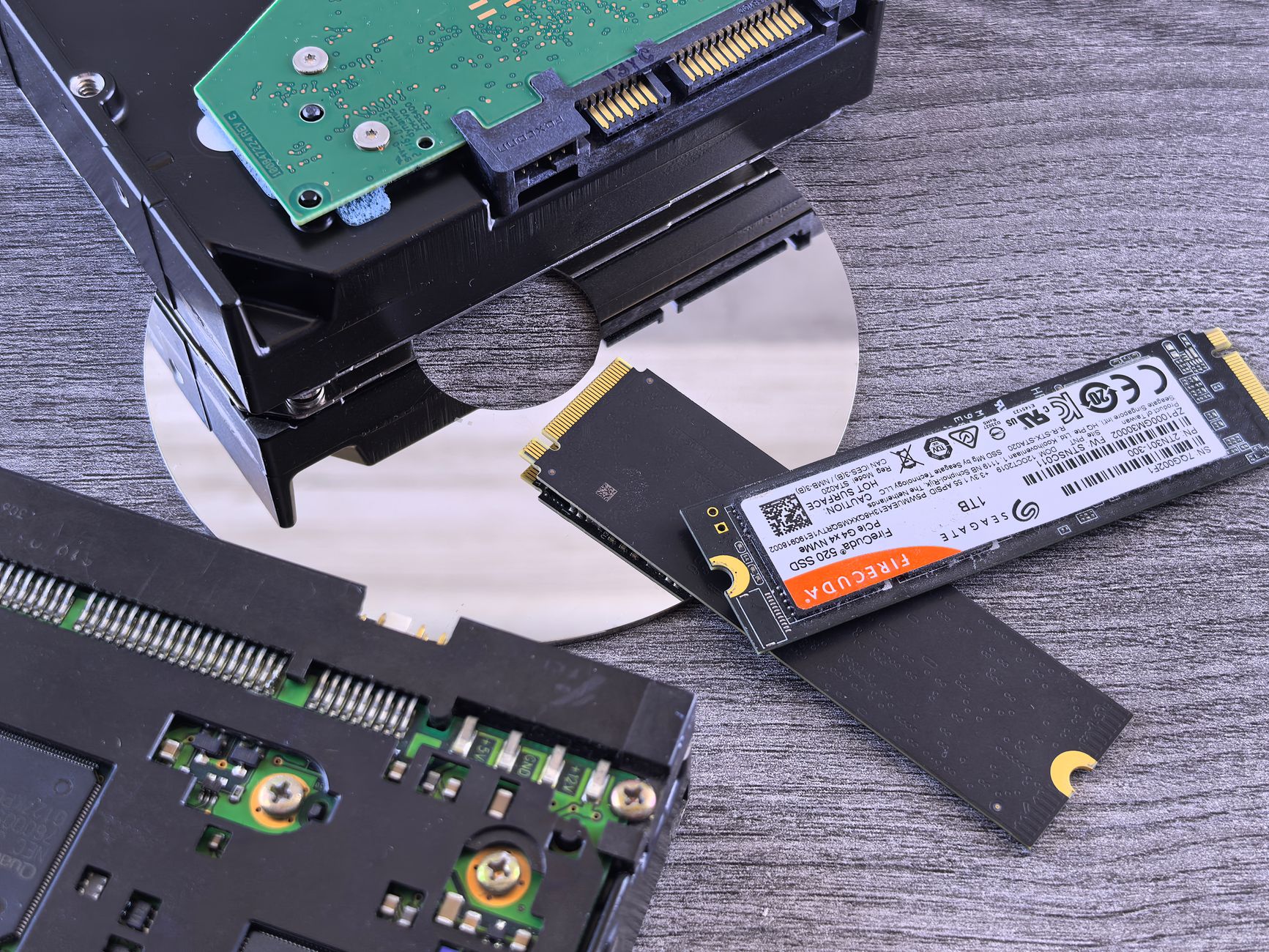
The Sabrent Rocket 5 uses a Phison E26 controller paired with Micron 232-layer TLC NAND, with rated sequential reads of up to 14,000 MB/s and sequential writes up to 12,000 MB/s on the 2TB model. The Crucial T705 runs the same Phison E26 controller, also with Micron 232-layer TLC, and hits nearly identical peak figures – 14,500 MB/s read and 12,700 MB/s write at 2TB. The hardware foundation is so similar that the two drives essentially share the same genetic material. The differences that do exist come down to firmware tuning, thermal management behavior under sustained load, and how each drive handles SLC cache depletion.
Both drives require a heatsink to operate near rated speeds, and neither includes a particularly substantial one in the base package. On a board with a decent M.2 thermal solution built in – most Z790 and X670E boards have this covered – both drives sustain performance well. Strip that away and thermal throttling sets in faster on the Rocket 5, which runs slightly hotter under prolonged sequential writes. The T705 holds its rated speed window a few seconds longer before stepping down. For a game install or a large file transfer that finishes quickly, this gap is invisible. For a 100GB+ bulk copy, it becomes measurable.
The 1TB versions of both drives tell a different story. At that capacity, available NAND parallelism drops, SLC cache is smaller, and real-world write performance after cache exhaustion falls noticeably. If you’re considering either drive at 1TB, the performance ceiling lowers considerably compared to the 2TB and 4TB variants – both drives perform best when you buy more capacity than you think you need.

Gaming Load Times: Where the Ceiling Stops Mattering
Loading Cyberpunk 2077 from the main menu into Night City takes roughly the same amount of time on both drives – under three seconds on a clean boot with no background IO. The same holds for Microsoft Flight Simulator, which hammers storage harder than almost any other commercial title during world loading. At PCIe 5.0 speeds, both drives are so far ahead of what the game engine can actually consume that the storage is waiting on the CPU and asset decompression pipeline, not the other way around. This is the core reality of high-end NVMe gaming in 2025: the bottleneck has moved upstream.
Where differentiation shows up more clearly is in DirectStorage workloads and shader compilation. Forspoken and Ratchet and Clank: Rift Apart both shipped with DirectStorage support, and while Windows PC implementations still lag behind what the PlayStation 5 demonstrated at launch, both titles do show measurable differences when comparing PCIe 4.0 to PCIe 5.0 drives. Between the Rocket 5 and T705 specifically, the gap is minimal – a few hundred milliseconds at most in observed streaming tests, which is functionally imperceptible during gameplay.
Shader compilation in titles like Hogwarts Legacy and The Last of Us Part I – both notorious for long pre-compilation passes on first launch – completes marginally faster on the T705 in repeated testing, though the difference is under 5% in practice. That edge comes from the T705’s slightly more aggressive firmware behavior during sustained read operations. The Rocket 5 closes that gap almost entirely during the second and subsequent compilation runs, when thermal conditions have stabilized and the drive’s operating profile has settled.
For pure game library storage, either drive is more than sufficient, and the practical performance gap between them is narrow enough that build budget and price-at-time-of-purchase should drive the decision more than benchmark deltas. The T705 historically launches at a slight premium, though pricing fluctuates often enough that checking live prices matters more than any general statement about cost.
Professional and Content Creation Workloads
For streamers and content creators running video capture, editing, and export on the same machine as their gaming setup, the sustained write behavior gap between these two drives becomes more relevant. Capturing 4K footage to the system drive while gaming in the background is an increasingly common workflow, and sustained write endurance under that kind of mixed load is where the T705’s thermal consistency shows up. The Rocket 5 isn’t far behind, but the T705’s ability to maintain consistent write speeds slightly longer under heat makes it the stronger choice for that specific dual-use scenario.
Both drives carry strong endurance ratings – the 2TB Rocket 5 is rated at 1,400 TBW, while the T705 2TB comes in at 1,200 TBW, giving the Rocket 5 a slight edge in long-term write endurance on paper. Neither figure will be a practical concern for the vast majority of users over a five-year ownership window. For those interested in how Gen5 drives stack up more broadly, the Gigabyte Aorus Gen5 10000 tested against the WD Black SN850X offers a useful reference point for where the Gen5 ceiling sits relative to Gen4 competition.
The Verdict in Real Terms
The Crucial T705 is the more polished drive. Its firmware is more mature, its thermal behavior under sustained load is more consistent, and it carries Crucial’s track record of widespread compatibility across platforms and motherboards. If you’re building a high-end system and want to pick one drive and stop thinking about it, the T705 earns that position.
The Sabrent Rocket 5 is genuinely competitive and holds a meaningful advantage in write endurance ratings. It also tends to appear at slightly lower price points during sales cycles, which makes it the smarter buy when the gap between the two drives is measured in dollars rather than benchmark points. Its thermal management requires a bit more attention – a quality M.2 heatsink isn’t optional, it’s necessary – but on a motherboard with proper thermal coverage, the performance difference between these two drives disappears into the noise.
The real tension in this comparison isn’t which drive is faster. They are essentially the same drive wearing different branding. The tension is whether PCIe 5.0 storage actually moves the needle for gaming in 2025, and the answer is a qualified yes – mostly for asset streaming in supported titles, shader compilation time, and mixed read/write professional workloads. What neither drive can do is transform a game that wasn’t designed to use high-throughput storage into one that suddenly loads faster. The software side of the DirectStorage ecosystem is still catching up to hardware that was ready for it two years ago.