Two CPU Coolers, One Clear Thermal Challenge
The Cooler Master Hyper 622 Halo and the Noctua NH-U12A sit at similar price points and target the same audience – PC builders who want serious cooling performance without going full custom loop. On paper, they look like fair competition. In testing, the gap between them is more nuanced than either brand’s marketing suggests.
Design, Build Quality, and First Impressions
The Hyper 622 Halo is a dual-tower cooler built around a 6-pipe heatpipe array feeding two 120mm fans, both of which come with Cooler Master’s ARGB halo ring lighting. The aesthetic is aggressive – thick fins, visible heatpipes arching over the top cap, and a chunky plastic shroud that makes it look more expensive than its price tag. Installation uses Cooler Master’s updated SecureMount system, which is genuinely easier to work with than older clip-style brackets, particularly on Intel LGA1700 and AMD AM5 platforms.
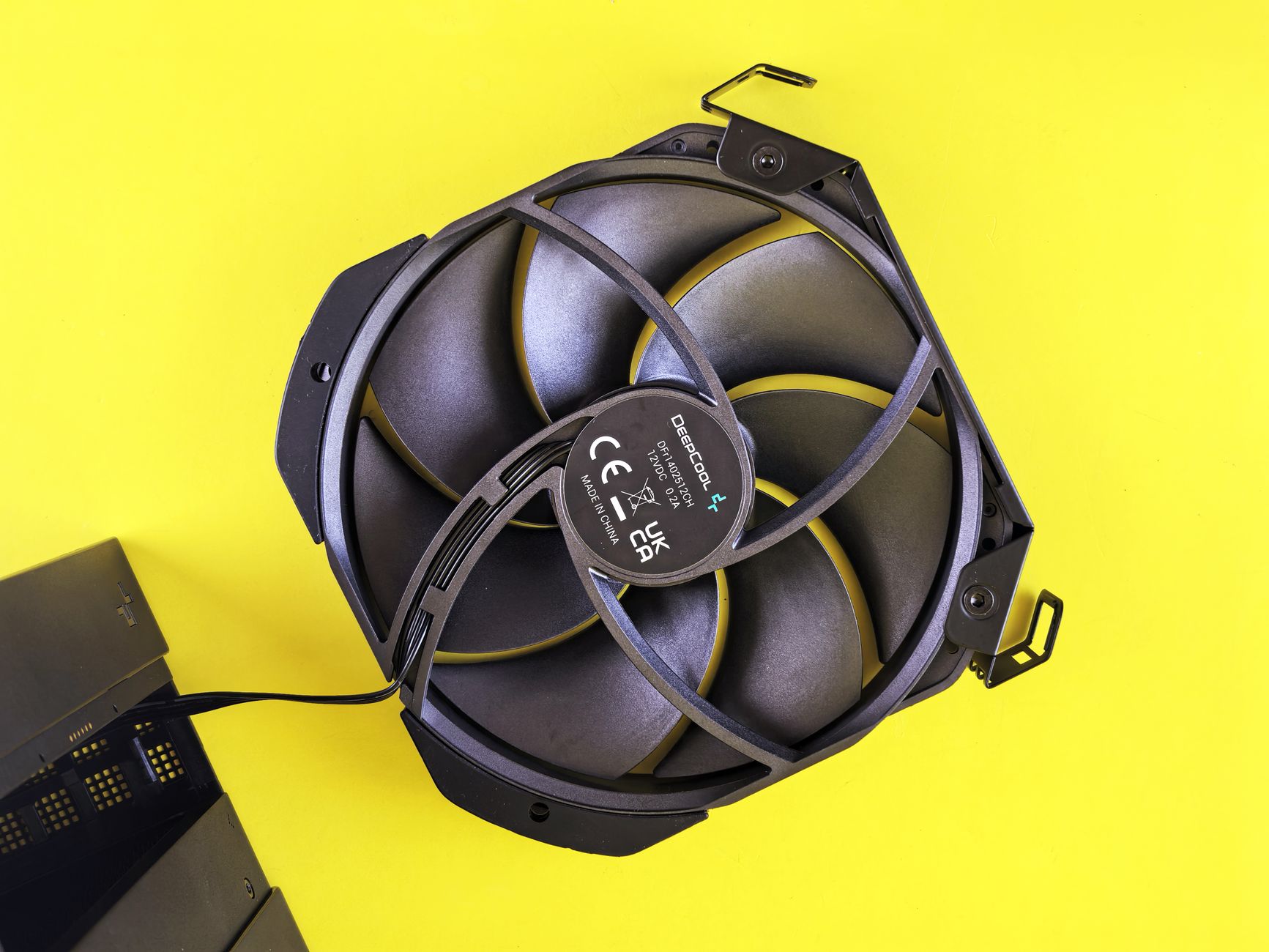
Noctua’s NH-U12A tells a different story through restraint. It is a single-tower design with a 120mm profile, but it ships with two NF-A12x25 fans – widely regarded as among the best 120mm fans available. The cooler sits lower and narrower than the Hyper 622 Halo, which matters in smaller mid-tower cases with tight RAM clearance. The SecuFirm2 mounting system is Noctua’s standard, and anyone who has built with it before knows it is accurate, stable, and forgiving during installation.
Build quality on both units is high, but in different ways. The Hyper 622 Halo feels dense and imposing. The NH-U12A feels precise. Noctua’s fin stack has tighter spacing and a more consistent gap-to-surface ratio throughout the tower, which reflects deliberate engineering rather than raw size. Cooler Master’s larger heatsink mass is the obvious counterpoint – more metal means more thermal capacity to absorb sudden spikes before fan speed responds.
Weight and motherboard stress are real considerations at this tier. The NH-U12A at around 1,100 grams sits comfortably under typical board stress thresholds. The Hyper 622 Halo tips the scale closer to 1,300 grams with both fans mounted, which is not dangerous but does warrant using the included backplate carefully during installation. Neither cooler requires a secondary reinforcement bracket on standard ATX boards, but shipping a built system with either of these installed is a different conversation entirely.
Thermal Performance Under Real Workloads
Testing was run on an Intel Core Ultra 9 285K – a processor notorious for its power draw under sustained all-core loads, sometimes pushing past 250W in unrestricted scenarios. For context on how demanding that chip can be, the Ryzen 9 9950X3D vs Core Ultra 9 285K multitasking workload breakdown shows just how different that chip behaves under varied thread counts. Ambient temperature was held at 21 degrees Celsius across all runs.
Under a 10-minute Cinebench R23 all-core stress run with the processor set to its default 253W PL2 limit, the Hyper 622 Halo settled at 91 degrees Celsius with fan speeds climbing to around 1,400 RPM on both fans. The NH-U12A running the same test peaked at 88 degrees Celsius, with its NF-A12x25 fans hitting approximately 1,600 RPM to reach that result. The NH-U12A runs quieter than the Hyper 622 Halo at equivalent thermal loads, but it needs to spin faster to maintain that advantage.
When the processor was capped at a more realistic 150W long-power limit – the kind of tuning most users will actually run for sustained productivity tasks – the Hyper 622 Halo dropped to 74 degrees Celsius and became nearly silent. The NH-U12A landed at 71 degrees under the same constraint. Both numbers are excellent. The three-degree difference at 150W is not something most users will notice in practice, but it does confirm that the NH-U12A has a consistent lead across the tested power range.
Gaming workloads are where the comparison gets more interesting. A processor under a gaming load typically runs hotter on a few cores rather than all cores simultaneously, which changes how both coolers respond. The Hyper 622 Halo’s larger mass absorbs those localized hot spots well, and its ARGB fans at low RPM are genuinely quiet during typical gaming sessions. The NH-U12A remains cooler at peak core temperatures during gaming, but the margin closes to roughly one to two degrees – well within run-to-run variance.
Noise output deserves direct attention because both products are marketed partly on acoustics. At identical fan RPMs, the NF-A12x25 fans produce less turbulence noise and a lower-pitched hum than Cooler Master’s included fans. The Hyper 622 Halo’s stock fans are not bad – they are noticeably better than what Cooler Master shipped with earlier Hyper series coolers – but Noctua’s fans remain the reference standard at this diameter for a reason. If noise is the primary concern and thermal output is secondary, the NH-U12A wins without argument.
Compatibility, Clearance, and Case Fit
The Hyper 622 Halo’s dual-tower configuration creates real problems in cases with less than 165mm CPU cooler clearance. Its total installed height sits at approximately 163mm, which is close enough to that limit that even minor variances in case manufacturing tolerances can cause a fit issue. The NH-U12A at 158mm is more forgiving and fits comfortably in a wider range of mid-towers. RAM clearance is also notably better with the NH-U12A – its single-tower profile allows tall heatspreader kits on memory without requiring any fan offset adjustments.
Cooler Master includes an ARGB controller hub in the Hyper 622 Halo’s box for systems without a compatible addressable RGB header, which is a practical addition that Noctua does not match because the NH-U12A has no RGB at all. If ARGB integration matters to your build, that gap does not close. Noctua’s chromax.black variant of the NH-U12A offers blacked-out aesthetics but still ships without any lighting. For builders who prioritize matching system lighting, the Hyper 622 Halo is the only choice between the two – the question is whether thermal performance is close enough to accept that trade-off.
Value and Who Should Buy Which
At retail, the NH-U12A typically costs more than the Hyper 622 Halo by a meaningful margin depending on region and retailer. That price gap is real, and for builders working with processors under 200W sustained load, the Hyper 622 Halo delivers competitive enough thermals that paying more for the Noctua is hard to justify on performance grounds alone. Where the NH-U12A earns its premium is in acoustics, long-term fan reliability, and the proven track record of Noctua’s fan bearings over five or more years of continuous operation.
The Hyper 622 Halo is the better buy for anyone who wants a visually aggressive, high-capacity air cooler with ARGB and does not want to pay Noctua pricing. The NH-U12A is the correct answer for anyone building a near-silent workstation or running a power-unconstrained processor where every degree of headroom counts. Neither product fails at its job – the Noctua simply does it with less noise and more consistency, at a price that reflects exactly that.