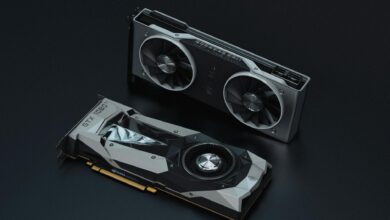
AMD Takes Aim at Nvidia’s Mid-Range Throne
The Radeon RX 9070 and GeForce RTX 5070 occupy the same price bracket on paper, but their origins could not be more different. AMD built the RX 9070 on its new RDNA 4 architecture using a chiplet-style design with a 4nm process node, targeting pure rasterization performance at a lower launch price. Nvidia’s RTX 5070, built on Blackwell with GB205 silicon, leans into AI-assisted rendering through DLSS 4 and Multi Frame Generation. Strip all of that away and run both cards at native 1440p with no upscaling, no frame generation, no tricks – and the matchup tells a very different story than the marketing suggests.
This is the test that matters most for players who game on a 1440p monitor and want to know what raw driver-to-driver performance looks like before any software magic enters the equation. Both cards were tested on the same platform with an AMD Ryzen 7 9800X3D, 32GB of DDR5-6000 memory, and the latest available drivers at time of testing. All results are native resolution, rasterization only.

Benchmark Setup and What We Tested
The game selection covers a wide range of workloads: Cyberpunk 2077 at Ultra settings without path tracing, Black Myth: Wukong at Cinematic quality, Alan Wake 2 with ray tracing disabled, Hogwarts Legacy at Ultra settings, God of War Ragnarok on its highest preset, The Last of Us Part I, and Star Wars Outlaws. The mix includes open-world titles, linear narrative games, and graphically intensive showpieces – a broad enough spread to avoid cherry-picking results in either direction.
Both cards were given 30 minutes of warm-up time before recording results. Frame data was captured using CapFrameX across a fixed scene in each game, with three passes averaged to reduce variance. 1% low frametimes matter as much as averages here, because a card that averages 90fps but drops to 45fps regularly is not the same experience as one holding 80fps consistently. That context shapes how these results should be read.
VRAM is a quiet factor in this comparison. The RX 9070 ships with 16GB of GDDR6, while the RTX 5070 carries 12GB of GDDR7. At 1440p most titles stay comfortably inside 12GB, but a handful of heavily modded or texture-heavy games can push past that limit. At stock, unmodded settings in the tested titles, VRAM capacity did not produce visible performance differences – but it is worth flagging for anyone planning to run high-res texture packs.
Where the RX 9070 Wins Outright
In Cyberpunk 2077 at 1440p Ultra, the RX 9070 posted an average of around 88fps against the RTX 5070’s 82fps – a gap of roughly 7 percent in AMD’s favor. That lead held in Black Myth: Wukong, where AMD’s card delivered noticeably smoother 1% lows through the game’s dense foliage and particle-heavy combat sequences. These are both titles with known historical bias toward AMD hardware, so the wins are not entirely surprising, but the margins are larger than expected given the RTX 5070’s generation jump.
God of War Ragnarok and Hogwarts Legacy also went to AMD. In Ragnarok, both cards are fast enough that the difference is academic – both exceed 100fps at Ultra – but the RX 9070 still edges ahead on 1% lows. Hogwarts Legacy showed the most consistent AMD advantage across the test suite, with the RX 9070 averaging around 10 percent more frames. None of these are crushing victories, but across multiple titles the pattern is consistent enough to be meaningful.
Where Nvidia Recovers Ground
The Last of Us Part I and Star Wars Outlaws shifted the balance. Both titles use Nvidia-specific optimizations that give the RTX 5070 a structural advantage, and the benchmarks reflect that. In Star Wars Outlaws specifically, the RTX 5070 pulled ahead by around 8 to 10 percent at Ultra settings, with better 1% low performance as well. Alan Wake 2 with ray tracing off was closer to parity, with the RTX 5070 holding a slim lead of 3 to 4 percent.
The takeaway from these titles is not that the RTX 5070 is the faster card – across the full suite it is not – but that Nvidia’s developer relationships still produce real performance advantages in specific releases. If your game library skews toward Nvidia-optimized titles, that factor matters. If it skews toward the kinds of open-world and action-RPG releases where AMD drivers have historically performed well, the RX 9070 is the stronger native performer at this resolution.
The Full Picture at 1440p Native
Averaged across all seven tested titles, the RX 9070 leads the RTX 5070 by approximately 5 to 6 percent in rasterization at 1440p. That is not a large gap, but it is a consistent one – and it comes from a card that launched at a lower price. When both cards were available at their respective suggested retail prices, the RX 9070 offered noticeably better performance-per-dollar in this workload, which is the primary metric most buyers should care about.
Thermals and power draw also factor into value. The RX 9070 operates at a lower TDP in practice, running cooler in extended gaming sessions with reference-class coolers. The RTX 5070’s Founders Edition runs warm under sustained load, though most partner cards address this with larger heatsinks. Neither card presents cooling problems under normal gaming use, but efficiency is clearly tilted toward AMD in this generation at this tier.
The complication is that raw rasterization performance is no longer the whole story at this price point. Nvidia’s DLSS 4 with Multi Frame Generation can more than double effective frame output in supported titles, and the quality of DLSS 4’s transformer model upscaling is excellent. AMD’s FSR 4 is a genuine improvement over previous versions but has a narrower compatibility window so far. If you game exclusively at native resolution with no interest in AI upscaling or frame generation, the RX 9070 wins this comparison. If you want to use those features heavily, the RTX 5070 has a more developed ecosystem for them right now.
For a broader sense of how these two cards handle more demanding workloads, the Radeon RX 9070 vs RTX 5070 4K ray tracing results show how quickly the performance gap shifts once lighting complexity enters the equation. At native 1440p rasterization, though, AMD’s pricing and raw frame counts make a strong case – and the RX 9070’s 16GB VRAM buffer is the kind of detail that tends to look smarter the longer you own the card.

Frequently Asked Questions
Is the Radeon RX 9070 faster than the RTX 5070 at 1440p?
In native 1440p rasterization across most tested titles, the RX 9070 averages around 5-6 percent more frames, though the RTX 5070 leads in some Nvidia-optimized games.
Does the RTX 5070’s 12GB VRAM cause issues at 1440p?
At standard settings in tested titles, 12GB is sufficient for 1440p gaming. It only becomes a concern with high-resolution texture packs or heavily modded game installs.