Two Cards, One Target: The 4K Rasterization Question
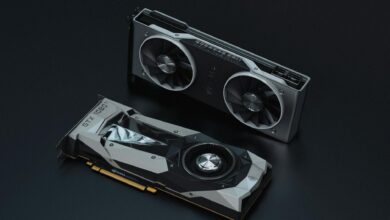
AMD’s Radeon RX 9070 and NVIDIA’s GeForce RTX 5070 are aimed at the same type of buyer – someone who wants serious performance without spending flagship money. Both cards sit in a price bracket that used to mean 1440p gaming, but AMD and NVIDIA are both pushing the narrative that this generation finally makes 4K rasterization viable at the mid-to-high tier. That claim deserves real scrutiny, not just benchmark cherry-picking from either camp’s marketing decks.
The RTX 5070 launches at $549, while the RX 9070 comes in at $549 as well – a pricing collision that makes the head-to-head almost unavoidable. Strip away upscaling, strip away frame generation, and what you’re left with is raw rasterization performance at 3840×2160. That’s the number that matters most for players who want native or near-native 4K without leaning on AI assistance to carry the frame rate.

Hardware Differences That Actually Matter at 4K
The RX 9070 is built on RDNA 4 architecture with 16GB of GDDR6 memory on a 256-bit bus, delivering around 644 GB/s of bandwidth. The RTX 5070 counters with GDDR7 on a narrower 128-bit bus, but NVIDIA’s memory compression and caching architecture partially offsets that bandwidth gap on paper. At 4K, memory bandwidth becomes a real bottleneck in texture-heavy scenes, and the 9070’s wider bus gives it a structural advantage in titles that aren’t optimized for NVIDIA’s memory compression pipeline.
The RX 9070 packs 3,584 shader processors under RDNA 4, while the RTX 5070 brings 6,144 CUDA cores running on the Blackwell architecture. Raw shader counts don’t translate directly between AMD and NVIDIA’s architectures, so the core count disparity is less meaningful than it looks at first glance. What matters more in rasterization workloads is how efficiently each architecture dispatches draw calls and manages geometry pipelines under 4K loads.
Power consumption tells part of the story too. The RX 9070 runs a 220W TDP, while the RTX 5070 sits at 250W. Neither card is a power hog by current standards, but AMD’s lower power draw at comparable or better rasterization output is a meaningful efficiency win – especially for builders running tighter PSU configurations or smaller form factor systems.
What the Benchmarks Actually Show
Across a broad range of rasterization-heavy titles at 4K – including Cyberpunk 2077, Alan Wake 2, Hogwarts Legacy, and Black Myth: Wukong – the RX 9070 and RTX 5070 trade wins depending heavily on which game engine is doing the rendering. In Cyberpunk 2077 with ray tracing disabled and path tracing off, the 9070 holds its own within a few frames per second of the 5070, and in some scenes edges ahead due to bandwidth advantages in its open-world traversal loads.
Hogwarts Legacy at 4K ultra settings without any upscaling shows the RTX 5070 pulling a clearer lead – typically in the range of 8-12% higher average frame rates in CPU-limited scenarios where NVIDIA’s driver stack and Unreal Engine optimization historically play in its favor. Black Myth: Wukong, built on Unreal Engine 5 with heavy use of Nanite and Lumen, is a mixed picture: AMD has improved its UE5 performance dramatically with RDNA 4 driver updates, closing a gap that was embarrassingly wide on RDNA 3 hardware.
The titles where the 9070 most consistently wins or ties in 4K rasterization tend to be DirectX 12-native games that don’t rely heavily on NVIDIA’s proprietary optimization agreements. Games like Assassin’s Creed Shadows and Resident Evil 4 Remake show the 9070 performing at or above the 5070’s output, with 1% lows that are often tighter on AMD’s side – a sign that RDNA 4’s memory architecture handles sudden scene complexity better in those specific workloads.
Where the RTX 5070 consistently separates itself in rasterization is in titles with aggressive shader compilation pipelines and DX12 Ultimate features. Microsoft Flight Simulator 2024 at 4K ultra is a case where the 5070 maintains noticeably smoother frame pacing, with the 9070 showing occasional stutters on first-fly-through in new terrain regions. This is a known pattern with AMD hardware and shader pre-compilation – a problem that has gotten better with RDNA 4 but hasn’t fully disappeared.

Looking at sustained 4K performance over long gaming sessions, thermal throttling is not a concern for either card when paired with a decent case and airflow. But frame consistency – the difference between an average frame rate and what you actually feel – gives the 9070 a slight edge in heavily memory-bound scenes, while the 5070 recovers faster in shader-intensive moments. For a straight rasterization comparison at 4K with no upscaling involved, the verdict comes down to your game library more than any single performance metric. If your catalog leans heavily toward NVIDIA-partnered titles and Unreal Engine 5 releases, the 5070 earns its keep. If you’re playing a broader mix of AMD-friendly and DirectX 12 native titles, the 9070 at the same price point is genuinely hard to argue against – and its 16GB frame buffer will have more room to breathe as 4K texture packs continue to scale upward over the next two to three years.