AMD vs Nvidia at 1440p: The Ray Tracing Question
Ray tracing has long been Nvidia’s home turf. From the RTX 20 series onward, Nvidia built its marketing around hardware ray tracing acceleration, and for years that advantage was real enough to matter. AMD’s response has been gradual – improving with each generation, closing gaps, but rarely pulling ahead. The RX 9070, based on AMD’s RDNA 4 architecture, changes that story in ways that deserve a closer look, particularly at 1440p where ray tracing loads hit hard enough to separate capable cards from pretenders.
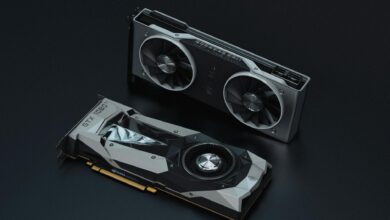
The RTX 5070 sits at roughly the same price point – both cards targeting the $549-$599 range depending on AIB partner and availability. On paper, Nvidia brings Blackwell’s fourth-generation RT cores and DLSS 4 with Multi Frame Generation. AMD counters with RDNA 4’s overhauled ray accelerators and FSR 4, now running on an ML-based upscaler for the first time. Neither card is a budget play. The question is which one gives you more actual performance when scenes are lit with ray-traced reflections, shadows, and global illumination at 2560×1440.
Architecture Differences That Actually Matter for Ray Tracing
RDNA 4 represents AMD’s most aggressive ray tracing redesign since the feature first appeared on Radeon hardware. The RX 9070 doubles the ray accelerator count compared to RDNA 3, and AMD restructured how the hardware handles BVH traversal – the process of testing rays against scene geometry. On RDNA 3, traversal and shading competed for the same compute resources, creating bottlenecks in complex scenes. RDNA 4 separates these workloads more cleanly, which shows up most clearly in games with dense ray-traced geometry like path-traced implementations.
Nvidia’s Blackwell architecture uses fourth-generation RT cores that handle both triangle and bounding box intersection tests in dedicated hardware, keeping the shader cores free for lighting calculations. It is a mature design that Nvidia has refined across four GPU generations. The RTX 5070 also benefits from a larger L2 cache compared to its Ada predecessor, which helps reduce memory bandwidth pressure during ray traversal. Both architectures are genuinely competitive now in a way that was not true even two generations ago.
Benchmark Results: Where Each Card Wins and Loses
In Cyberpunk 2077 at 1440p with ray tracing set to Ultra and path tracing disabled, the RTX 5070 holds a roughly 10-12% frame rate lead over the RX 9070 before any upscaling is applied. That gap narrows when FSR 4 Quality mode enters on AMD’s side, because FSR 4’s machine learning reconstruction is genuinely better than FSR 3 was – sharper, with less ghosting on fast-moving reflective surfaces. Enable DLSS 4 Quality on the Nvidia side and the gap opens back up again, with the RTX 5070 running noticeably smoother in the rain-soaked streets of Night City.
Path tracing in Cyberpunk 2077 – the most demanding ray tracing workload available in any retail game – tells a starker story. The RX 9070 struggles more at native resolution here, dropping into frame rates that require upscaling to be playable. The RTX 5070, while also needing DLSS to hit smooth performance, handles the path tracing workload with more headroom. This is the scenario where Nvidia’s RT hardware maturity still shows.
Alan Wake 2 with full ray tracing enabled at 1440p is a more balanced matchup. AMD’s improvements in ray-traced diffuse lighting calculations close the gap considerably, and in several scenes the RX 9070 trades blows with the RTX 5070 within a margin that would be imperceptible during actual gameplay. The RTX 5070 still leads overall, but not by the double-digit percentage Nvidia held in previous generations. Control RT, Metro Exodus Enhanced Edition, and Dying Light 2 with ray tracing show a similar pattern – Nvidia ahead, but AMD within striking distance for the first time.
Returnal on PC with ray-traced shadows and reflections active is worth singling out because it represents a ray tracing workload that RDNA 4 handles particularly well. The RX 9070 closes to within 5% of the RTX 5070 here, and with FSR 4 enabled, the AMD card delivers comparable real-world playability. It suggests the gap between these two cards is heavily dependent on the specific ray tracing implementation, not a blanket advantage for either side.
Upscaling Reality: FSR 4 vs DLSS 4
Both cards need upscaling to make ray tracing at 1440p consistently comfortable across demanding titles. FSR 4 is a genuine leap for AMD – the ML-based reconstruction handles motion and fine detail noticeably better than the spatial FSR 3 algorithm. On supported titles, FSR 4 Quality mode holds up well against DLSS 4 Quality mode in static screenshots. In motion, DLSS 4 still produces slightly cleaner results on hair, foliage edges, and fast-moving reflections, but the gap is smaller than it has been at any point in AMD’s upscaling history.
The practical catch is game support. DLSS 4 with Multi Frame Generation is available in a growing library of titles, and frame generation adds a meaningful boost to perceived smoothness in ray tracing scenarios where the GPU is clearly the bottleneck. AMD’s Fluid Motion Frames 2 is AMD’s frame generation answer, but its game compatibility list remains shorter. If you play primarily in the overlap of titles supporting both ecosystems, the experience is comparable. If you play across a wider library, Nvidia’s ecosystem coverage is still broader.
Value Consideration and Who Should Buy Which
At matching MSRP, the RTX 5070 delivers better ray tracing performance on average across a wide game library – call it a 10-15% lead in most titles, growing larger in path tracing scenarios and shrinking in others. Whether that lead justifies a preference for Nvidia depends entirely on what you play. If your library is heavy on titles that use Nvidia-exclusive features like DLSS 4 and ray reconstruction, the RTX 5070’s ecosystem advantages compound on top of its raw RT performance.
The RX 9070 makes a genuinely strong case for players whose primary interest is 1440p gaming with ray tracing enabled at moderate settings rather than maximum path tracing. It handles Ultra ray tracing in most titles smoothly with FSR 4 engaged, and its rasterization performance is competitive enough that you are not giving up anything when ray tracing is turned off. For a detailed look at how these two cards compare specifically in rasterization workloads, the Radeon RX 9070 XT vs RTX 5070: 1440p Rasterization Tested comparison covers that ground thoroughly.
What the RX 9070 cannot do is match the RTX 5070 in path-traced workloads, and that ceiling matters if you want to run Cyberpunk 2077 with path tracing at a smooth frame rate without leaning heavily on frame generation. Nvidia holds that specific high ground, and for buyers who prioritize the most technically demanding ray tracing implementations available right now, that distinction is real enough to drive a purchase decision.
Frequently Asked Questions
Is the RX 9070 good for ray tracing at 1440p?
Yes, the RX 9070 handles standard ray tracing at 1440p well with FSR 4 enabled, though it falls behind the RTX 5070 in path tracing scenarios.
Does DLSS 4 give the RTX 5070 a big advantage over FSR 4?
DLSS 4 still produces cleaner motion and edge detail than FSR 4, but the gap has narrowed significantly with FSR 4’s new ML-based reconstruction in supported titles.