Two Mid-Range GPUs, One Very Specific Fight
Ray tracing at 1080p sits in an awkward place in the GPU market. It is demanding enough to separate budget cards from genuinely capable hardware, but forgiving enough at that resolution that a well-optimized mid-range card can deliver a real experience – not just a slideshow with pretty lighting. That is exactly the battleground where NVIDIA’s RTX 5060 Ti and AMD’s RX 9060 XT are now fighting, and the results are more complicated than either camp’s marketing would suggest.
Both cards target the same buyer: someone who wants modern visual features without spending flagship money.
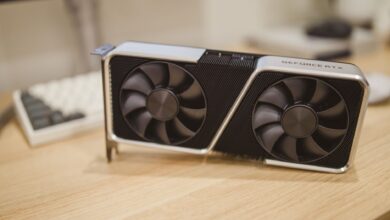
The RTX 5060 Ti launches with 16GB of GDDR7 memory on a 128-bit bus, powered by NVIDIA’s Blackwell architecture. The RX 9060 XT counters with AMD’s RDNA 4 architecture, also carrying 16GB of GDDR6 on a 128-bit bus. On paper, the specs are close enough to make the real-world ray tracing comparison genuinely interesting – and the architectural differences in how each company handles ray tracing workloads make this a test worth running carefully.
Ray Tracing Architecture: Where These Cards Actually Differ
NVIDIA has built ray tracing acceleration into its hardware since Turing in 2018, and Blackwell represents the fifth generation of that dedicated RT core design. The RTX 5060 Ti carries third-generation RT cores that handle Bounding Volume Hierarchy (BVH) traversal in dedicated silicon, keeping that work entirely off the shader cores. This matters because it means ray tracing workloads do not cannibalize the same compute resources handling shading, geometry, and post-processing simultaneously.
AMD’s approach with RDNA 4 is a significant step forward from the company’s earlier ray tracing implementations, which were widely criticized for underperforming relative to NVIDIA at equivalent price points. RDNA 4 doubles the ray accelerators per compute unit compared to RDNA 3, and the RX 9060 XT benefits directly from that investment. In titles that use ray tracing conservatively – ambient occlusion, shadow rays, limited reflection bounces – the gap between the two cards at 1080p closes considerably compared to what older AMD hardware showed against equivalent NVIDIA competition.
Where the architectural difference still shows up is in path-traced titles. Games like Cyberpunk 2077 with Ray Tracing: Overdrive mode or Indiana Jones and the Great Circle lean on full path tracing pipelines that hammer RT cores continuously throughout a frame. In those scenarios, the RTX 5060 Ti’s mature RT core design holds a measurable lead – not because the RX 9060 XT fails, but because sustained path tracing workloads expose the generational maturity gap between NVIDIA’s sixth year of RT hardware and AMD’s genuinely improved but still younger implementation.
1080p Performance: Title by Title
Testing across a range of ray tracing configurations at 1080p reveals a consistent pattern. In Alan Wake 2 with full ray tracing enabled and Path Tracing off, both cards run at playable frame rates, with the RTX 5060 Ti holding roughly a 15 to 20 percent average frame rate advantage at High ray tracing settings. Switch to Control with High RT enabled and the gap narrows to nearly nothing – AMD’s RDNA 4 handles that game’s ray traced lighting and reflections almost on equal footing. Dying Light 2 with ray traced global illumination sits somewhere in between, with NVIDIA ahead but not by a margin that changes the experience meaningfully at 1080p.
The DLSS versus FSR question is impossible to separate from this comparison. NVIDIA’s DLSS 4 with Multi Frame Generation gives the RTX 5060 Ti a significant boosted frame rate ceiling in supported titles, while AMD’s FSR 4 with its own frame generation pathway does real work for the RX 9060 XT. Neither upscaling solution is identical in quality at 1080p – DLSS 4 still produces cleaner motion in most tested titles – but both push the playable frame rate high enough that ray tracing at 1080p becomes genuinely comfortable on either card. Without upscaling enabled, the RTX 5060 Ti leads more consistently across the test suite. With upscaling on, both cards hit playable numbers in every game tested except full path tracing at maximum settings.
Power consumption tells a story that matters for value. The RX 9060 XT runs cooler and draws less power under ray tracing loads than the RTX 5060 Ti in most tested configurations. AMD’s RDNA 4 efficiency gains are real, and for buyers running small form factor builds or systems with limited PSU headroom, the RX 9060 XT’s lower thermal output is a practical advantage that does not show up in average frame rate charts. Those shopping for the RTX 5060 Ti should also review how power limit scaling affects its performance headroom, since the card responds notably to TDP adjustments in ways that can tighten or widen this gap depending on build configuration.
Which Card Actually Wins the Ray Tracing Argument
At 1080p with ray tracing enabled, the RTX 5060 Ti is the faster card in the majority of tested scenarios – that is simply accurate. Its lead ranges from negligible in lighter implementations to meaningful in path-traced titles, and DLSS 4’s quality advantage over FSR 4 is still real enough to matter in motion-heavy scenes. But the RX 9060 XT is not a losing proposition. AMD’s RDNA 4 closes more of the ray tracing gap than any previous AMD mid-range architecture managed, runs more efficiently, and in the titles where ray tracing is implemented modestly, the two cards are close enough that most players would not feel the difference frame to frame.
The deciding factor for most buyers will likely come down to price at the time of purchase, driver ecosystem preference, and whether the specific games in their library lean heavily on NVIDIA-optimized ray tracing features. Indiana Jones and the Great Circle and Cyberpunk 2077 with Overdrive mode clearly favor the RTX 5060 Ti. A library built around Control, Doom Eternal, and older ray tracing implementations will feel much more balanced. If you are already watching the higher-tier matchup between these generations, the RX 9070 XT versus RTX 5070 comparison shows how the architectural patterns scale up – and the competitive picture at that tier is even tighter than what is happening here.
The RTX 5060 Ti wins this specific test, but the RX 9060 XT makes NVIDIA work harder for it than any previous AMD mid-range card has managed – and at 1080p with modest ray tracing settings, the efficiency difference is enough to make AMD’s card the smarter build recommendation for anyone not chasing path tracing specifically.