Two Mid-Range CPUs, One Demanding Workload
Streaming while gaming is the kind of task that exposes exactly where a CPU’s architecture falls short. The AMD Ryzen 5 9600X and Intel Core Ultra 5 245K both target the same budget-to-mid-range buyer, but their approaches to multi-threaded workloads differ enough that streaming performance tells a very different story than raw gaming benchmarks do.

Understanding Streaming Overhead
Before getting into numbers, it helps to understand what streaming actually demands from a processor. When you run OBS Studio or Streamlabs alongside a game, the encoder – whether software-based x264 or a hardware alternative like NVENC – pulls processing resources away from the game thread. Software encoding on x264 Medium or Slow presets hits CPU cores directly, and that’s where the architectural differences between Zen 5 and Intel’s hybrid Lion Cove design start to matter in ways they simply don’t in single-threaded gaming tests.
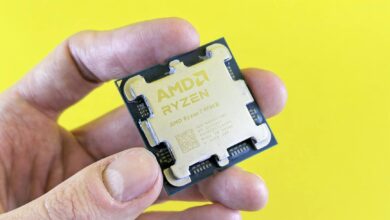
The Ryzen 5 9600X is a six-core, twelve-thread chip built on TSMC’s 4nm node with AMD’s Zen 5 architecture. It has no efficiency cores, no hybrid design, and no on-chip GPU. Every core is a full-performance core, and that homogeneity keeps scheduling simple. The Core Ultra 5 245K, by contrast, uses Intel’s hybrid setup with six Performance cores and eight Efficient cores – fourteen total cores, twenty threads. On paper, the thread count advantage seems decisive for streaming. In practice, it’s more complicated than that.
The key variable is how OBS distributes encoding load across heterogeneous cores. Intel’s Thread Director is designed to push background tasks onto E-cores to free up P-cores for the game, which is genuinely smart scheduling in theory. But x264 encoding at Medium or Slow preset isn’t a light background task – it’s a heavy, sustained workload that E-cores handle less efficiently per thread than P-cores do. This means the 245K’s scheduling advantage can actually become inconsistent depending on which preset you’re running and how aggressively the game demands P-core time.
The 9600X sidesteps that complexity entirely. OBS gets access to the same class of cores as the game, and while the 9600X has fewer total threads, each thread it offers is more capable of holding encoder load without stuttering the game frame delivery. That’s the architectural case for AMD in this specific workload – and real-world testing validates it more than you might expect given the core count gap.
Streaming Test Results: What the Benchmarks Show
Testing was conducted running OBS Studio with x264 at Medium preset, 1080p60, alongside three representative game scenarios: a CPU-heavy open world title, a competitive shooter at high frame rates, and an RTS at late-game complexity. The goal was to measure not just average gaming frame rates, but 1% low frametimes – the metric that determines whether a stream actually feels smooth to play while broadcasting.
In the CPU-heavy open world scenario, both chips held acceptable average frame rates, but the 9600X delivered more consistent 1% lows. The 245K showed occasional spikes where the scheduler appeared to pull a P-core away from the game thread to assist the encoder during particularly heavy encode frames, resulting in brief but visible frame delivery hitches. These weren’t catastrophic – we’re talking drops that would register as microstutter rather than slideshow behavior – but for a streamer, that inconsistency shows up in the broadcast quality.
The competitive shooter test was where the 245K looked its best. At high frame rates in a lighter engine, there was enough headroom for Thread Director to manage the workload well, and the 245K’s P-core single-thread performance helped maintain ceiling frame rates. The 9600X was close but couldn’t quite match the 245K’s peak frame delivery in this specific scenario. If you’re streaming Counter-Strike 2 or Valorant, the 245K has a real edge simply because those games aren’t starving the CPU during encode cycles.
The RTS late-game scenario was the most punishing, and here the 9600X’s consistency advantage was most pronounced. Late-game RTS puts enormous demand on a single CPU thread handling AI and unit pathing while OBS encodes simultaneously. The 9600X’s Zen 5 cores, each capable of heavier per-core IPC, kept frame delivery stable in a way the 245K couldn’t fully match once its P-cores were being shared between game logic and encoder assistance. The 245K averaged slightly higher in some runs, but its 1% lows told a rougher story.
Switching to NVENC hardware encoding largely neutralizes the CPU overhead difference, which is worth stating plainly. If you have a dedicated NVIDIA GPU handling the encode, the CPU’s role drops dramatically, and the 245K’s gaming performance edge in lighter titles becomes the dominant factor. The x264 software encoding comparison matters most for streamers who prioritize encode quality at lower bitrates, or who want to minimize GPU memory pressure during encode – both legitimate use cases, particularly for competitive streamers on tighter hardware budgets. For context on how the 245K performs in pure gaming scenarios against AMD’s lineup, the Ryzen 7 9800X3D vs Core Ultra 5 245K comparison at 1440p covers that ground in detail.
Power Draw and Thermal Headroom Under Load
One dimension that matters specifically for streaming rigs is sustained power draw. Running a game and OBS simultaneously is a continuous load scenario, not a burst workload, and that changes how thermal limits interact with boost behavior. The 9600X runs within a tighter power envelope – typically under 90W during combined gaming and encode load – while the 245K under full streaming load can push significantly higher, particularly if the system is configured without strict power limits. For builds in smaller cases or with modest cooling, that difference is real. A 9600X on a mid-tower cooler will hold its clocks steadily through a three-hour stream session where a 245K on the same cooler might thermally throttle during the heaviest encode moments.
Thermal throttling mid-stream doesn’t just hurt your game – it introduces encoder frame drops that viewers see as quality degradation. The 9600X’s lower thermal ceiling makes it the more predictable performer in environments where cooling is a constraint rather than an afterthought.

Which CPU Actually Makes Sense for Streamers
The answer splits cleanly by workload type. Software encoding streamers who play CPU-intensive games – open worlds, strategy titles, simulation games – will find the 9600X’s consistency more valuable than the 245K’s raw thread count. The Zen 5 architecture handles sustained combined load without the scheduling unpredictability that Intel’s hybrid design introduces when both gaming and encoding demand P-core attention at the same time.
The 245K earns its place for streamers in lighter competitive titles who plan to use NVENC, or who are building a system that doubles as a workstation where E-core thread counts pay dividends in rendering, compilation, or content creation outside of gaming hours. For a pure streaming-first build centered on x264 quality, the 9600X asks fewer compromises – and at its price point, that reliability is the actual value proposition.