Air vs. Water: The Cooler War That Never Gets Old
Every few years, the PC building community revisits the same fundamental question: does premium air cooling still hold its own against a quality all-in-one liquid cooler? Right now, two products sit at the top of that conversation – the Noctua NH-D15 G2, the long-awaited refresh of what many consider the gold standard of air coolers, and the Arctic Liquid Freezer III, a 360mm AIO that has been quietly dismantling the argument that you need to spend $150 or more on liquid cooling to get serious performance.
Both coolers target high-end desktop processors. We’re talking systems built around chips like the Ryzen 9 9950X3D or Intel Core Ultra 9 285K – processors that push thermal loads hard enough to expose the real difference between a cooler that looks impressive on paper and one that actually keeps thermals stable under sustained workloads.
This is not a close match on every metric.
Noctua NH-D15 G2: What Changed and Why It Matters
The original NH-D15 launched in 2014 and spent nearly a decade as the default recommendation for anyone who wanted serious air cooling without the maintenance concerns of a liquid loop. The G2 is not just a cosmetic refresh. Noctua redesigned the base plate geometry to better address the uneven heat spreader surfaces on modern Intel and AMD processors, and the company offers three mounting variants – LBC (Low Base Convexity), HBC (High Base Convexity), and standard – specifically to match different socket configurations. That level of engineering detail is why Noctua commands premium pricing, currently around $150 for the NH-D15 G2.
The fan configuration ships with two NF-A15 PWM fans running in a push-pull setup. At full load on an AMD Ryzen 9 9950X, the NH-D15 G2 holds junction temperatures in the low-to-mid 80s Celsius during extended Cinebench R23 multi-core runs, which is genuinely strong performance for air cooling at that TDP range. Fan noise at full speed is noticeable but not aggressive – Noctua’s fan tuning remains among the best in the industry. The cooler does have a size penalty: at 168mm tall, it blocks the first RAM slot on many motherboards and will not fit in compact mid-tower cases without checking clearance specs carefully.
What the NH-D15 G2 offers beyond raw numbers is consistency. Air coolers do not have pump failure risk, there are no cold plate contact variations over time, and there is no coolant to degrade. For a workstation or gaming PC that runs for years without being opened, that reliability argument carries real weight. The G2 also ships with Noctua’s NT-H2 thermal compound, which performs well without requiring any cure period.
Arctic Liquid Freezer III 360: The Budget AIO That Punches Up
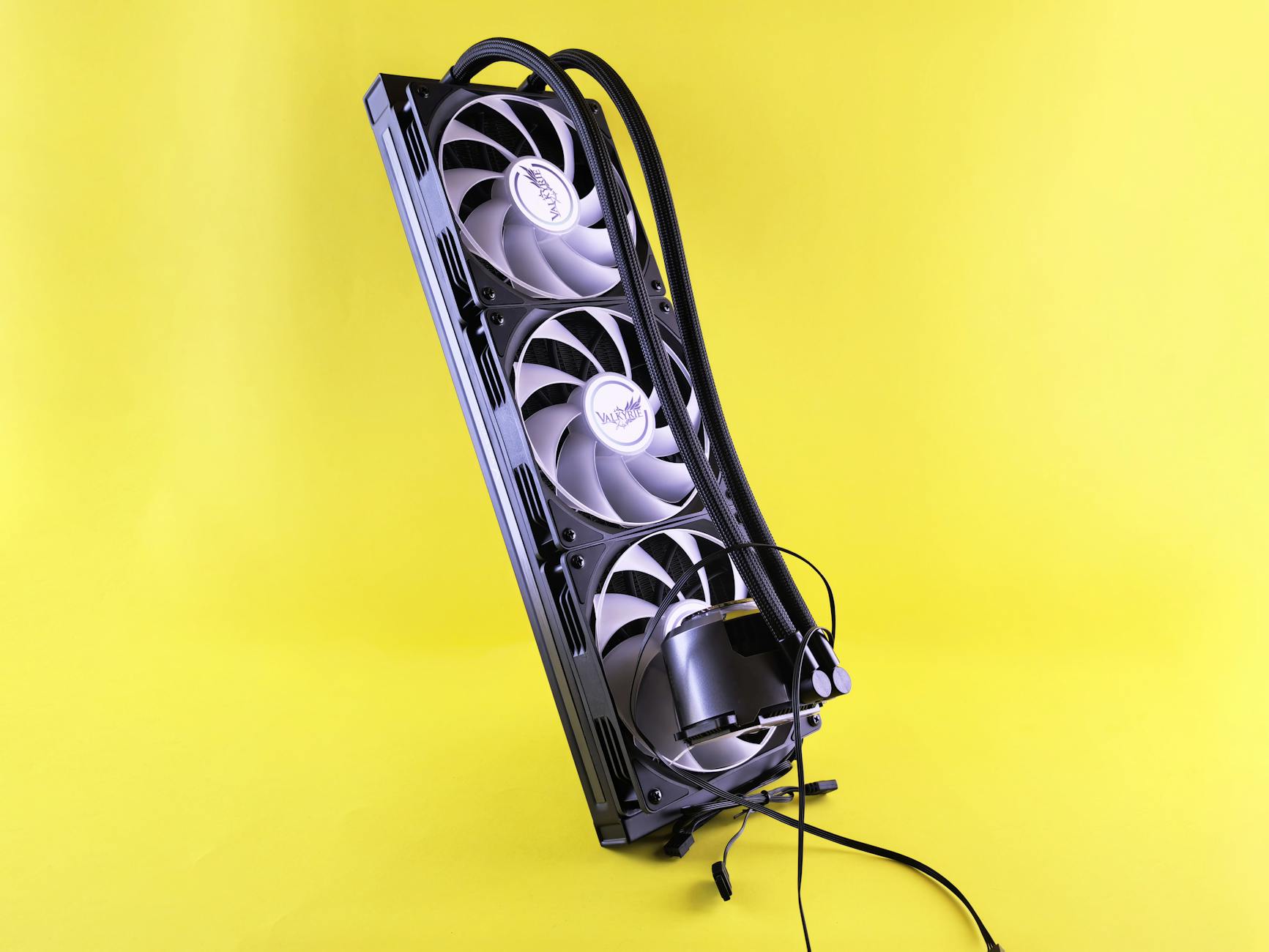
Arctic priced the Liquid Freezer III 360 aggressively – typically around $90 to $100 – and for that price it delivers a dense 360mm radiator, a 40mm thick radiator design that maximizes surface area, and a pump head that incorporates a small VRM fan to push airflow across motherboard components near the CPU socket. That VRM fan is a genuine differentiator, particularly on boards where VRM cooling is marginal under heavy all-core workloads.
In thermal testing against the same Ryzen 9 9950X, the Liquid Freezer III 360 pulls ahead of the NH-D15 G2 by approximately 5 to 8 degrees Celsius under sustained all-core loads. That gap matters most in scenarios where the processor is running at full power for extended periods – video encoding, 3D rendering, or heavily threaded compilation tasks. For gaming workloads, where most processors spend significant time in boosted single-core or lightly threaded states, the real-world difference narrows considerably and the NH-D15 G2 keeps pace without breaking a sweat. The Liquid Freezer III does produce more audible noise from its pump under heavy load, a persistent critique of the original Liquid Freezer II that Arctic has only partially addressed in this generation.
Case compatibility is where liquid cooling earns its keep in compact and mid-tower builds. The Liquid Freezer III installs in the top or front of most mid-towers with 360mm radiator support, leaves RAM slots fully accessible, and does not raise any GPU clearance concerns. For builders working inside cases like the Fractal Design North or Lian Li Lancool 216, the AIO route simply opens more layout flexibility than a dual-tower air cooler can match.
Which One Should You Actually Buy
The NH-D15 G2 wins on longevity, acoustics at moderate loads, and the specific peace of mind that comes from a cooler with no moving parts beyond fans you can replace individually. The Arctic Liquid Freezer III 360 wins on peak thermal headroom, price-to-performance ratio, and compatibility with tighter builds. If you are running a processor that regularly sustains all-core turbo – whether for content creation or simply because you prefer not to limit power targets – the Liquid Freezer III’s thermal advantage at its price point is hard to argue against. If noise is your primary concern and your workloads are mixed gaming and light productivity, the NH-D15 G2 will run quieter and cost you about $50 more for the privilege of never worrying about pump longevity.
The Liquid Freezer III 360 currently sits around $95 on most major retailers while the NH-D15 G2 hovers near $150 – meaning Arctic delivers competitive or better thermal performance for about 63 cents on the dollar. That price gap is the argument Noctua still has not fully answered.